Main menu







A tremor is an involuntary, rhythmic shaking or quivering movement which can occur in the hand, arm, foot, leg, and chin. Approximately 70% of people with Parkinson’s experience tremor. The most common initial location for a Parkinson’s tremor is in a person’s hands or arms.
If you have a tremor, activities can also take longer to accomplish than they once did. Tremors can cause complications with many activities of daily living that involve fine motor skills, such as brushing teeth, shaving, bathing, getting dressed, writing a letter, and eating.
The good news is that although a tremor is bothersome and can be embarrassing, it is not incapacitating or life-threatening. In addition, there are many actions you can take to manage this symptom. In this post, we’ll take a look at the causes of tremor, types of tremor, and strategies to manage it so you can live well with Parkinson’s.
Imbalances in neurotransmitters cause tremors. As dopamine cells are damaged because of Parkinson’s, a neurotransmitter called acetylcholine becomes over-expressed, and this excess results in involuntary shaking movements. In the early stages of Parkinson’s, tremor is typically seen on one side of the body; however, as Parkinson’s progresses, tremor may impact both sides and affect more body regions. The patterns, forms, and progression of tremors are individual to each person.
There are many different types of tremor. Here, we’ll discuss those that are most common for people living with Parkinson’s.
The most common tremor in Parkinson’s is a resting tremor, which occurs when a person is at otherwise still When the affected part of the body is actively moving, resting tremors tend subside. For example, if a person’s hand tremors while sitting and waiting for someone, once that person moves their hand to wave and greet the person they were waiting for, the tremor will often disappear. Similarly, resting tremor in the legs occurs when a person is lying down or sleeping or when one’s feet are dangling. Again, if one starts moving, the tremor disappears.
An action tremor is the shaking motion that occurs when a limb or body part is being moved or held in a non-resting position (for example when you hold a glass of water out to hand it to your friend).
While action tremors are much less common than rest tremors in people with Parkinson’s, more than 25% of people with Parkinson’s experience them.
Even though others cannot see an internal tremor, many people with Parkinson’s report a shaking sensation inside the chest, abdomen, or limbs. Because this internal tremor is difficult to explain to others and is often upsetting to the person with Parkinson’s, it can distract and interrupt the flow of what they’re doing. While internal tremors can be extremely difficult to identify and describe, they often respond to medications in a similar way that external tremors do.
Doctors often diagnose tremors through physical and neurological examinations and a medical history review. During the physical evaluation, a doctor will assess the tremor to see if it occurs when your muscles are at rest or in action, where they are located on your body, if they occur on one or both sides, and their frequency and amplitude. They will also assess other neurological functions such as walking, balance, speech, muscle tone, and mobility.
Medications can help with tremor, and if you’re using carbidopa/levodopa, the key to take your medications on schedule according to your care team’s advice, even if you don’t currently feel a tremor.
Having a constant medication level in your body by following your physician’s medication schedule can help prevent OFF times. OFF times are when your medications aren’t working optimally, and your tremor returns or worsens.
To minimize off times, create a habit of taking your medications at the same time each day and of taking your carbidopa/levodopa on an empty stomach with a full glass of water. Drinking a full glass of water when taking your pills helps flush the medicine quickly from your stomach to your small intestines, where it is absorbed. If you need help with medication management, talk with your physicians about wearable technologies that can help monitor movement fluctuations and determine proper medication dosages.

As the most common medication used to control movement symptoms of Parkinson’s, carbidopa/levodopa typically helps relieve tremors in people with Parkinson’s. Other medications, such as anticholinergics, are sometimes used to control tremors, but because these can cause significant mental and physical side effects, be sure to discuss all options with your doctor carefully.
Propranolol, a drug used for hypertension, heart disease, and migraine headaches, is occasionally helpful for managing parkinsonian tremors, as is clozapine, a treatment most commonly used to treat schizophrenia. For many years, clozapine required regular bloodwork to minimize risk of some serious side-effects. As of 2025, the FDA no longer requires this bloodwork, but talk to your doctor about the risks.
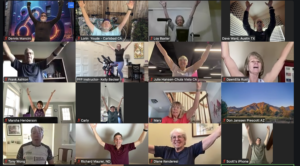
Exercise can help manage many motor symptoms of Parkinson’s, including tremor.
While studies show regular exercise can improve heart health, increase strength, improve endurance, reduce fatigue, and positively impact mood and self-esteem in all people, research studies have found that people with Parkinson’s who participated in high-intensity exercise experienced noticeable improvement in their overall movement and reduced tremor after exercising. (Also, individuals with Parkinson’s who exercised more often required less additional medication and had the slowest rate of change over a year.)

Of course, talk to your physician before starting any exercise program, but once you receive the go-ahead, find a form of movement that brings you joy. Whatever movement activity brings a smile to your face will help manage the motor symptoms of Parkinson’s, including tremor.
Doing just one thing at a time can lessen tremors that disrupt your ability to do what you want or need to do. For example, when eating, place your elbows on the table to stabilize your arms. Sit down when you brush your teeth, so you only need to focus on your upper body muscles. Hold your arms as close to your body as possible when writing a check. When you walk, keep your hands and arms free.
Paradoxically, practicing multi-tasking can help you manage tremor and other symptoms of Parkinson’s, too. The mechanisms of this phenomenon are not fully understood, but it is thought to relate to neuroplasticity and engaging brain circuits less affected by Parkinson’s. A physical or occupational therapist can help you learn how to practice multi-tasking safely.
Not completing tasks as efficiently as you could before you experienced tremor can be disheartening, stressful, and fatiguing. The next time you feel frustrated while trying to accomplish a task, take a few deep breaths to help rebalance your nervous system and allow your muscles to relax. Then, try the action again.
To help you everywhere—from the kitchen to the bathroom, bedroom, golf course, swimming pool, sidewalk, and more—there are tools, gadgets, and equipment designed especially for people who experience tremor. Whether it’s stretchy elastic shoelaces or a long-handled shoehorn to help you put on socks and shoes, an adaptive mouse for computer work, weighted silverware to help decrease tremor while eating, or Velcro buttons, a wide variety of devices can help you feel safe, become more confident when attempting various tasks, gain more independence, and increase self-efficacy.

You can begin managing your tremors today by practicing all the tips we just shared. The key is to take action now. The more you do today, the more vital, more mobile, and happier you will be while living with Parkinson’s.

The Every Victory Counts® manual offers clear, practical guidance to help you understand what to expect, what may change, and what you can do—drawing on insights from 80 clinicians and people living with Parkinson’s.


 Search





 Donate
 Find Support