Main menu







Written by Dr. Sarah King, PT, DPT
You’ve heard all the hype. Every Parkinson’s healthcare professional, researcher and advocate is shouting from the rooftops how wonderful exercise is supposed to be to help you improve your symptoms and slow the progression of the disease.
But you’ve had a different experience.
When you exercise, you feel like your symptoms get worse instead of better.
You’re afraid you’re the only one.
You’re worried that you’re the outlier who can’t reap the benefits of exercise.
Rest assured, it’s not just you.
As a Parkinson’s physical therapist, I regularly talk to people who struggle to get on board with a regular exercise program because the side effects after the fact are frustrating and disruptive.
In this article, I want to walk you through four reasons why your Parkinson’s symptoms may be getting worse after exercise, and how you can adapt your Parkinson’s exercise program to minimize the side effects so you (and your brain) can reap the benefits.
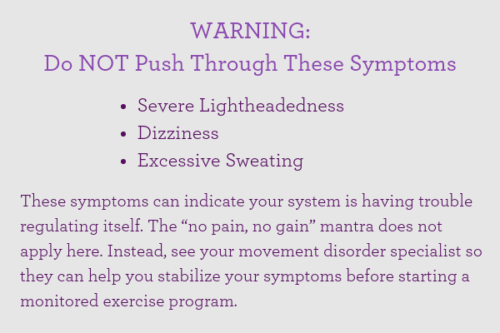
Immediately after exercise, you notice symptoms like tremors, dyskinesia or freezing are worse. This may last from a few hours to a few days.
Do you notice your symptoms are exacerbated when you’re under a lot of psychological stress? Exercise is a physical stress on your system and, while beneficial in the long run, it can impact your system in the same way that mental stress does in the short-term.
Ease your way into exercise, starting with 5-10 minutes of fast-paced walking a few times during the day. If you have a lot of stress and anxiety on a daily basis, try implementing 10-15 minutes of meditation or mindfulness to calm your nerves each morning so exercise isn’t taking your stress levels over the edge. Finally, schedule your workouts so you can relax afterward and aren’t anxious about getting from the gym to your next appointment.
You start your workout feeling relatively strong but then you hit a wall. You notice “wearing off” symptoms like stiffness, difficulty walking, worsening posture and increased slowness.
Your symptoms may be creeping back up during exercise because your medications are “wearing off”. This occurs with levodopa medications when you’ve reached the end of the effective dose and your dopamine levels are low.
Talk to your movement disorder specialist as they can help you modify the dose, timing or frequency of your medication schedule. Keep a log of your “on” and “off” times to share them along with any other important notes (like when you ate and exercised each day). Your physician may alter your medication or encourage you to change your dosages around exercise to keep you from “wearing off” mid-session.
You feel a general level of physical or mental exhaustion that stretches beyond normal tiredness. Just starting any workout is an accomplishment due to your utter lack of energy and motivation. When you do manage to exercise, you’re wiped out. You may notice walking seems incredibly difficult, due to heaviness in your legs or extreme freezing. Exercise is such an endeavor that you’re tempted to just avoid it altogether.
The energy-producing, stress-regulating cells in your body (called mitochondria) aren’t working effectively, leaving you lacking the energy it takes to exercise regularly.
While it feels counterproductive, exercising regularly actually improves how well your mitochondria function. However, it can take a few months to improve your exercise tolerance and you may need to take it slowly. Vow to stick with your exercise program for at least three weeks before throwing in the towel as this can be the minimum amount of time it takes to get over that initial hump. Finally, recognize that improving fatigue takes a comprehensive approach.
You’re working out on a fairly regular basis, but notice you’re not seeing the results you want. Your symptoms continue to creep up slowly without any real improvements in your flexibility, strength, balance, coordination or stamina.
When it comes to seeing results from your exercise, the intensity and consistency of your program are key. While you may be getting some general exercise benefits, you may not be challenging your brain and body in a way that’s effective for your Parkinson’s symptoms.
According to the research on Parkinson’s exercise, there are seven components to include in your Parkinson’s exercise program for optimal results. Layer these elements over your current exercise program for improved results.

As you can see, there are a number of reasons why your Parkinson’s symptoms may be getting worse after exercise and it may be hard to pinpoint exactly what’s happening on your own. This is where seeing a Parkinson’s trained physical therapist is incredibly beneficial. They can help you problem-solve your situation, personalize an exercise program and adapt it over time.
Find a PWR! Therapist here.
Find an LSVT BIG Therapist here.
 Sarah is a passionate Parkinson’s physical therapist whose mission is to help her clients build a personalized Parkinson’s Plan of Attack that helps them live a life full of energy and vitality, despite their diagnosis. She lives in Austin, Texas with her husband (and favorite human), Matt. Learn more about Invigorate Physical Therapy & Wellness at www.InvigoratePT.com.


 Search





 Donate
 Find Support