 Main menu



Difficulty maintaining a stable, balanced posture when standing or moving is a hallmark feature of Parkinson’s. This difficulty is called postural instability, and it is a common cause of falls for people with Parkinson’s.
Falls can have a wide range of consequences: while some may be only frustrating or embarrassing, others may be life-threatening due to head injury or fractures.
With the increasing use of smartwatches with fall detection capabilities, we often hear from people with Parkinson’s and their care partners who want to know what fall detection devices are best for people with Parkinson’s.
Smartwatch and other wearable technology is more sophisticated than ever, with the potential to yield both safety benefits and greater peace of mind for people with Parkinson’s and their families. All devices are not created equal, though. Read on for considerations to keep in mind as you consider smart devices for fall detection.
Balance is complicated. It involves not only maintaining a stable posture, but also making voluntary movements and responding to external forces.
While balance becomes a challenge for many people as they age and their strength and flexibility changes, people with Parkinson’s tend to have more substantial challenges with their balance. One reason for this is that Parkinson’s impacts how your brain combines information from your nervous and musculoskeletal systems and coordinates movement. Rigidity in Parkinson’s can also contribute to a stooped posture. These impacts alter your center of gravity and slow your reflexes, both of which increase the risk of falling.
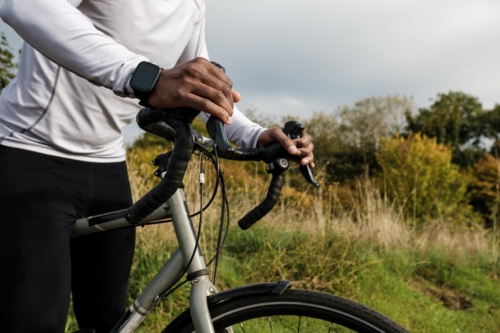
The most popular wearable device that is able to detect and report falls is the Apple Watch. Each Apple Watch model with fall detection can auto-dial 911 and your emergency contacts, if the appropriate settings are made on the watch and phone connected to the watch. Watches made by Garmin, Samsung, and other companies possess similar capabilities with similar options.
However, most experts believe the technology built into these widely marketed smartwatches is still not quite reliable enough for people with Parkinson’s. “I like it in the sense that you have a phone with you all the time,” occupational therapist Carol Chiang told us in a recent webinar, “but the [Apple Watch] fall algorithm… is meant for athletes.”
Users have reported that the Apple Watch missed medically significant falls, and a 2024 analysis concluded that the accuracy of these wristwatches in detecting falls was only moderate: “The devices were generally effective in identifying actual falls, with a sensitivity of 81.9%. However, they also generated a significant number of false positives.” A specific warning for wheelchair users: a 2022 study found a false negative rate of more than 95% for this group.
Purpose-built devices for those with specific medical needs remain ahead of the pack, and although there is little academic research on these products, numerous trustworthy, consumer-facing organizations have rigorously tested them. A 2025 review by the nonprofit National Council on Aging (NCOA) evaluated eight devices specifically for their fall detection capabilities, naming Medical Guardian best overall due to its fast response times and long battery life, although fall detection is an add-on not included in the basic monitoring plan.
UnaliWear’s Kanega Medical Alert Watch was NCOA’s highest-scoring wristwatch. It was also the top pick among medical alert systems according to the New York Times’ Wirecutter team, but the expensive subscription led the authors to recommend the more budget-conscious LifeFone Safe Watch Active device as well. People with Parkinson’s looking to combine the convenience of a wristwatch with more reliable fall detection than the Apple Watch might consider these devices.
Internet searches for information on wearable fall detection devices can turn up websites that claim to offer neutral evaluations, but these sites may be misleading. One we found while researching this article seemed to offer a useful feature-by-feature comparison of several products. Upon closer scrutiny, the review parameters appeared to be designed to exclude a single product that had scored well elsewhere, and the site offered no information about who paid the authors. Be careful.
Some fall detection and alert technology is quite expensive. If you have been buying cell phones or smartphones for years, you probably already know some ways to cut costs in those transactions: buying a refurbished or used device, changing your service provider or contract, and taking advantage of deals associated with new product launches are a few examples.
Here are some other options to pursue to make gear more affordable:
Watches and other wearable items can do a lot of things besides detect falls! Automatically calling for help is one of those things, but a device that is also equipped to monitor your vitals, track your treatments and symptoms, and help you take your medication on-time might be useful to you. For example, StrivePD automatically records data about Parkinson’s tremor and dyskinesia. StrivePD can even help with medication timing and exercise tracking as well.
Still, despite the potential they have, no device can completely erase the need to take a proactive approach that aligns with the other things you do to live well with Parkinson’s: exercise, take your medications, and keep your care team in the loop.
If you and your doctor think it makes sense, you might also consider the use of mobility aids such as a cane or poles, a walker, or a wheelchair. Mobility aids are available in a range from “analog” to digital. For instance, the Rollz Motion Rhythm rollator offers sound signals, vibrating handles, and laser-projected lines on the ground to aid in movement. And you might keep an ear open for new developments. Returning to additional words of wisdom from Carol Chiang: “I think we’re getting to a zone where things are a lot more about you [instead of] ‘women’ or ‘women of a certain age.’ That’s exactly what people with Parkinson’s need—they need to be able to have products that are for them, not just ‘people with Parkinson’s.’”
The first step toward in determining what might be right for you is to assess your needs and risks with your care team. After that, cost, convenience, battery life, and your comfort with technology are all factors you should consider when deciding whether wearable technology belongs in your toolbox for living well with Parkinson’s today.
A Primer on Balance and Parkinson’s
[Podcast] Gait, Balance and Falling
[Webinar Recording] Living Well Today: Home Safety, featuring occupational therapist Carol Chiang
How to Evaluate Online Reviews from the U.S. Federal Trade Commission


 Search





 Donate
 Find Support