 Main menu

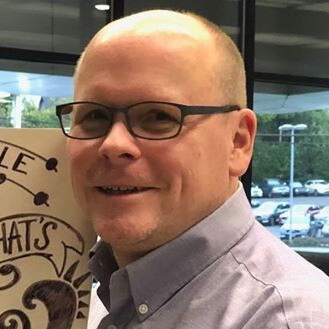




Written by Gregg Busch
Although Dr. James Parkinson first described the “shaking palsy” in 1817, Parkinson’s remains a profound enigma.
Parkinson’s refuses to follow a predictable script. If Parkinson’s has any consistency, it is its inconsistency. Every journey is unique; the onset is hard to diagnose and even harder to trace to a true beginning. While most Parkinson’s diagnoses occur between the ages of 60 and 70, I found myself among those who didn’t fit the mold.
My Parkinson’s diagnosis came when I was 50, but my symptoms had been whispering for nearly twenty years. Parkinson’s was not a stranger in my home; my mother, five of her siblings, and my maternal grandfather all lived with its variations. I recognized the signs a decade before my diagnosis, but I kept them a secret. I couldn’t bear to upset my mother with the news that the family legacy had claimed me, too.
When the diagnosis finally became official, my life turned upside down. But when the spinning finally stopped, I landed in a place of renewed purpose—a place where I now help others live well and fight for a cure.
To understand the impact of Parkinson’s, it helps to understand what it asked me to walk away from. I am a medical school graduate with a PhD and a career built on four decades of public speaking, research, and leadership. I served as a college president and a White House advisor, working in 14 countries to reform education. I climbed from a childhood of limited opportunity in rural Appalachia and became one of the top college presidents in the United States.
I was at the peak of my professional life when my neurologist calmly told me he could not release me to return to work. I was disabled. My career was over.
I went home that day and never saw my office again; my life’s work was eventually boxed up and mailed to me. For four months, I lived in a torturous depression. To go from a life of global influence to a life without perceived meaning was unbearable. Then, in a mere thirty seconds, everything changed.
At a routine appointment, a doctor opened the door and called for “Dr. Busch.” It was the first time I had heard that title since leaving the college. I had never been one to insist on titles, but in that moment, the weight of it broke me. I began to cry.
When the doctor asked why I was so emotional, I told him that I felt Parkinson’s had stripped me of my purpose. He scooted his chair closer and said:
“Parkinson’s may take your ability to walk, change how you talk, and make you shake like a leaf. It may even steal some memories. But it will never strip you of your doctorate or your ability to be an influencer.”
Those words sparked a pivot. I realized that while the work of my past was no longer feasible, I could reinvent myself once more. I decided to take the disease that had moved into the center of my life and use my research tools, my network, and my voice to change the landscape for others.
I leaned into this new mission, becoming an Ambassador for the Davis Phinney Foundation and the Parkinson’s Foundation, and an advocate for the Michael J. Fox Foundation. I was back in my element—speaking, teaching, and writing—and was even named a finalist for the 2026 Scott Newman Impact Award.
But as my influence grew, my mobility declined. I transitioned from a cane to a walker, and finally, to a wheelchair.
Recently, I was invited to keynote at a major leadership conference. It would be my first time on a stage in a wheelchair. I knew the visual would be jarring; I could practically feel the audience’s shoulders tense as they processed the sight of the chair. I had a choice: try to hide the disability by leaning on a podium or face it head-on.
I chose honesty. I took the stage and addressed the journey immediately, pivoting the focus from my physical seat to the power of the human spirit. Within five minutes, I watched the “nervousness” leave the room. The crowd relaxed, becoming so entranced by the story of recovery and reinvention that the wheelchair became invisible. By making disability a secondary issue, we were able to connect on a level that was deeper than any physical limitation.
As we reflect on Parkinson’s Awareness Month, I share my story to offer hope. Life with Parkinson’s is not over; it is simply different. You can live well. You can reinvent yourself to meet the challenges of this disease.
Whether you are diagnosed young or later in life, you have a choice. You can let the disease define you, or you can take control, make the necessary modifications, and find a new brand of hope. Purpose doesn’t always require a podium; it might be as simple—and as vital—as being the number one fan in the stands at your grandchild’s game.
You are still you. The journey continues.
Devon Cone’s 2026 Parkinson’s Awareness Month Post
Gene Rankey’s 2026 Parkinson’s Awareness Month Post


 Search




 Donate
 Find Support