Main menu






Postural instability, which essentially means poor balance and coordination, is a common Parkinson’s motor symptom. Parkinson’s can cause a loss of reflexes needed to maintain an upright posture, causing some people with Parkinson’s to feel unstable while standing upright. This instability, in turn, can increase their risk of falling.
The good news is that although balance is one of the most vulnerable mechanisms we have, it is also one of the most re-trainable. With practice, you can improve your postural stability and even regain some of your automatic balance reflexes. We’ll show you how.
Balance is a state of equilibrium. When you can control your body’s center of mass over its base of support, you remain upright and steady. Parkinson’s impacts on the brain cause delays in a person’s reaction time, speed of movements, and postural “righting reflexes,” which means that if your body sways off its base of support, it might take too long to “right” itself. All of these increase the risk of falling.
The basal ganglia, part of the brain responsible for motor control, plays an important role in balance. The basal ganglia is also the part of the brain impacted by Parkinson’s and is involved in dopamine production and use, but balance challenges in Parkinson’s are more complicated than just a dopamine deficiency. To balance effectively, your brain must combine information from all levels of your nervous and musculoskeletal systems.
The most common way a healthcare provider will test your balance is called a “pull test,” your doctor will stand behind you and give a tug to pull you backwards and observe how you react and how many steps it takes for you recover your balance.
A person without postural instability typically takes a quick backward step to prevent themselves from falling. A person with Parkinson’s, however, is often unable to recover and would fall backward if the doctor wasn’t there to catch them.
Build a care team of people who can help. Physical therapists can assess your balance and work with you to develop a personalized training program to address your balance deficits. Movement disorder specialists can prescribe personalized treatments—medication, complementary therapies, and/or surgery—for postural instability. Occupational therapists can help you create a safe living environment. And here are some tips on how to improve your posture.

And don’t forget that you are a very important part of your care team. Remember that balance is learned; we taught ourselves as toddlers to balance by practicing, again and again and again. Do the same now. Find ways to challenge your balance as often as you can.
Start by standing from a seated position. Is that easy? Now stand up with your eyes closed. Make this activity progressively more difficult as you complete the steps. Try placing a firm pillow on the floor by a wall where you can hold on if necessary. Now stand on the pillow. You are on your way to training your balance.
Dr. Hannah Fugle says the most effective balance exercises are high intensity; challenging and cognitively engaging (requiring your sustained attention in order to perform it well); repetitious (taking place every day or most days of the week); progressive (demanding more work and attention as your skills improve); meaningful (improving your quality of life); and enjoyable.
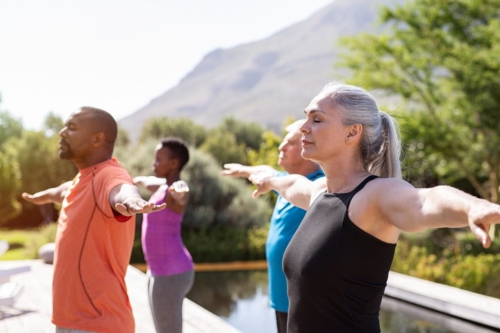
Explore exercises that focus on flexibility, strength, and agility, which are key ingredients to improving balance and coordination. Activities that incorporate elements of balance—such as yoga, tai chi, Pilates, boxing, and dance—are ideal for people with Parkinson’s because they not only relieve stress but they help build balance control.
“The goal of a balance exercise is to improve your body’s ability to gather sensory information, to keep you steady.”
-Dr. Hannah Fugle, DPT
Some people with Parkinson’s develop a tendency to lean back when rising from a chair, called retropulsion, which could cause them to fall backward. Daily exercises where you practice leaning forward while standing can help you develop this method.
Keep your posture in check by standing against a wall and making sure that not only your lower back touches the wall but also BOTH shoulder blades. Do this a few times a day.
Research shows, again and again, that exercise reduces Parkinson’s symptoms and improves quality of life. Studies show that it impacts the brain in a way that can help people with Parkinson’s regain some of their automatic balance reflexes.
“We know that if you are living with Parkinson’s, exercise helps to improve the effectiveness of your medications,” Dr. Fugle says. “It promotes the efficient use of dopamine in your brain. It slows the rate of loss of dopamine-producing cells in your brain, which can combat the breakdown of movement quality and at times restore some of the automaticity of movement that can be lost when you have Parkinson’s.”
Dr. Fugle added that studies have suggested that exercise might be neuroprotective. Researchers continue to explore how exercise can help protect nerve cells that are at risk for damage, degeneration, or cell death. Simply put, exercise strengthens the cells that are most vulnerable before they experience damage. Intensive, high-energy aerobic exercise has shown the most promise for exercise-induced neuroprotection and is actively under study in people with Parkinson’s.

Exercise may also help your body and brain find new ways to move and balance. Parkinson’s damages parts of the brain, and exercise aids your brain in discovering new nerve cell connections. This process is called neuroplasticity—disconnecting the “old wires” in the brain and redirecting to new wires to make different pathways.
This means degradation or changes in your brain are not static or concrete. There’s actually some room for adaptive changes within your nerve tissues. We need to be engaging in activities that are neuroprotective, but we’d also like to gain back as much lost ground as we can when it comes to dopamine neurons. This is possible with exercise—it can promote brain changes and improve blood flow and even potentially improve neurocircuitry or connections.”
-Dr. Hannah Fugle, DPT
If you have difficulty changing directions or with quick movements, try making a wide turn that looks like the letter “U” instead of a quick and potentially risky pivot that looks like the letter “V.”
When you’re standing, plant your feet shoulder-length apart instead of close together to create a more stable base for your body.
Use a fanny pack to carry things so that your hands are kept free and unrestricted. With both hands free, making a conscious effort to swing both arms can help you maintain balance.
The key is practice. Just like when you first learned to stand and walk, keep practicing. Build balance control exercises into your daily life (here’s a neat app that might help!), and reach out to others who can help you with this training. With practice, you can improve your postural stability and live well with Parkinson’s.
[Video] Victory Summit Event – Boise: Hannah Fugle, Physical Therapy and Parkinson’s
[Presentation slides] Victory Summit Event – Boise: Hannah Fugle, Physical Therapy and Parkinson’s
Occupational Therapy for Parkinson’s
What Cycling Options Do I Have when Balance and Space Are an Issue?
Did you know that you can prolong your mobility and improve your balance by taking care of your feet? Dr. Atul Gawande’s book, Being Mortal, dives deep into why feet are a critical part of living well.

The Every Victory Counts® manual offers clear, practical guidance to help you understand what to expect, what may change, and what you can do—drawing on insights from 80 clinicians and people living with Parkinson’s.


 Search





 Donate
 Find Support