Main menu






Written by Dr. Sarah King, PT, DPT
“You need to focus on your core!”
This buzz word – “the core” – exploded in the late 80s (anyone remember the Abdominizer?) and infomercials have taken the term and run with it, making billions of dollars in the process.
Contrary to popular belief, and to the detriment of ab products everywhere, you don’t have to have a six-pack (or even a two-pack!) to have great core strength.
But what exactly does it mean to have a “strong core”?
And why is it important for someone with a Parkinson’s diagnosis?
In this four-part mini-series, we’re going to discuss what your “core” is, why it matters and guide you through a series of exercises that will help you build one that is flexible, strong and coordinated.
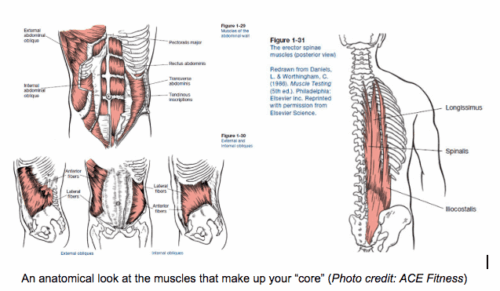
The “core” is made up of the major muscle groups that move, support and stabilize your spine.
Any time you bend forward, backward, to the side or twist, you’re using more than a few of your 35+ core muscles that wrap around the front, sides and back of your torso and hips.
You use your core in almost every activity you do throughout the day unless you’re laying flat on your back and not moving. You’re engaging your core to some degree every time you turn over, stand up, walk, reach, lift and breathe.

The degree to which your core muscles are able to control the movements you do throughout the day is considered your core strength.
There are four things you need to have in order to have a solid core:
 Without core muscles to hold you up, you’d move around like the Tube Man.
When the muscles that make up your core are strong and work well together, everyday tasks get much easier:
In addition, core stability training has been shown to improve low back pain.
While a complete and balanced Parkinson’s exercise program goes beyond exercises focused on the core musculature, adding some of these exercises to your regular rotation can be beneficial in many ways.
This four-part series is designed to help you lay a foundation of core strength with exercises that not only build a stronger core, but also help improve some symptoms specific to Parkinson’s including posture, stiffness and rigidity.
Each day we’ll focus on a different aspect of core strength and stability:
Day1: Spinal Flexibility (below)
Day 2: Pelvic Floor and Deep Abdominal Strength
Day 3: Abdominal, Lumbar, and Hip Strength
Day 4: Coordination
As a general rule, you can aim to do these exercises three to five times per week to see results. However, every person is different. Listen to your body and never push through pain!
Download this checklist to help you keep track of your core exercise routine.
| DISCLAIMER: Always consult your physician before beginning any exercise program. This general information is not intended to replace your healthcare professional. Consult with your physical therapist and healthcare team to design an appropriate exercise prescription. If you experience any pain or difficulty with these exercises, stop and consult your healthcare provider. |
An important part of core strength is making sure that your joints are in proper alignment. Over time, especially with Parkinson’s, that alignment can become compromised.
Muscles tighten.
Joints stiffen.
Posture suffers.
This is why, during the first week of our Parkinson’s Core Strength Exercise Mini-Series, we’re going to focus on improving the flexibility of your spine and the muscles that surround it.
The four exercises described below are designed to loosen you up and help you regain proper postural alignment so your core muscles can work as they were designed.
Perform once daily for best results.

STARTING POSITION: Lying flat on your back, legs straight.
Hold the twist for 5 deep breaths.
Switch and repeat on the right side.
Perform 2 times per side.

STARTING POSITION: Lying on your left side, head resting on the mat.
Repeat opening and closing your arms in a deep twist 10 times.
Switch and repeat on the opposite side.
Perform one time on each side.
*PWR!Moves ® is a PD-specific skill training program to maintain or restore skills that deteriorate and interfere with everyday movements. Dr. Becky Farley created PWR!Moves® as the EVOLUTION of her original LSVT BIG® exercise program and you can read more about it at www.pwr4life.org/moves.

STARTING POSITION: On hands and knees.
Hold this position for 10-30 seconds.
Repeat 2-3 times.
If this doesn’t feel great on your knees, try Option 2.

STARTING POSITION: Standing.
Hold for 10-30 seconds.
Repeat 2-3 times.

STARTING POSITION: Lying flat on your back. If your head does not touch the floor, you may put a small pillow under your head. If you have low back pain, put a small pillow under your knees.
Hold for 5 seconds.
Repeat 10 times.
When you’re able to comfortably get into the position above, try adding an additional challenge by doing this exercise against the wall.

STARTING POSITION: Standing with back flat against the wall. Try and stand as straight as possible with your back, shoulders, and head against the wall.
Hold your most upright/aligned position for 5 seconds.
Rest and repeat 10 times.

STARTING POSITION: Standing with back flat against the wall, hands against the wall with palms forward. Try and stand as straight as possible with your back, shoulders, and head against the wall.
Perform 10 “angel wings” without letting your head or shoulders leave the wall.
Rest and perform a 2nd set of 10.
Download the pdf of day one exercises here.
We’ll be back tomorrow for part two of the mini-series.
 Sarah is a passionate Parkinson’s advocate who founded Invigorate Physical Therapy & Wellness, an online wellness practice 100% specialized in Parkinson’s disease, to help her clients get out of overwhelm and into action by connecting them with the tools and support they need to thrive over the course of their Parkinson’s journey. She lives in Austin, Texas with her husband (and favorite human), Matt.
Download the PDFs from this Parkinson’s Core Strength Exercise Mini-Series for free here.


 Search





 Donate
 Find Support